

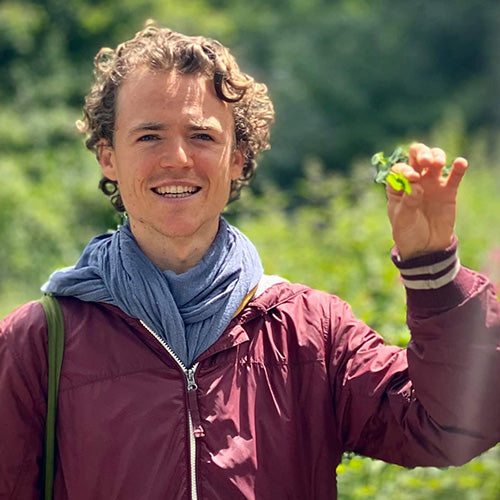
Philip Kunisch: "Nature awaits eyes that see it!"

Philip Kunisch: "Nature awaits eyes that see it!"
Interview with the herbalist, nutrition and health consultant
"Unlike their botanical counterparts from greenhouses and cultivation, wild plants are exposed to various stressors such as cold and heat, humidity or drought, nutrient poverty, and predators, and develop enormous resilience in the form of secondary plant compounds – and it is precisely from these that we can benefit so much! When we pick a plant in the wild, it doesn't even know it has been picked yet – and passes on all its valuable ingredients and vitality to us." Herbalist Philip Kunisch, author of the compact guide "Edible Medicinal Herbs and Wild Plants", believes it is extraordinarily valuable for us modern people to rediscover the ancient knowledge of our ancestors and sees in our native medicinal and wild plants a wonderful opportunity to do much good for our health and to "shake up our sometimes mundane and profane everyday lives through new realms of experience."
You understand your compact guide "Edible Medicinal Herbs and Wild Plants" not only as a reference work, but as an invitation to rediscover nature. What powers and knowledge do we need to regain in order to live in harmony with it?
Philip Kunisch: First, I would like to sincerely thank you for the opportunity to express my opinion here and to share some thoughts and values that accompanied me on the way to this book. This question can be answered intellectually, but the real answer must be experienced. Who can convey the feeling of standing at the edge of the forest at sunrise while the birds sing their morning song? These are energizing forces, uplifting, refreshing, and touching forces. In essence, no extraordinary knowledge is required. The art lies more in letting go of our concepts and ideas so that we can consciously experience all of nature's gifts. An inner attitude of respect for nature is very beneficial. A quote from the artist Alfred Bast states, in essence: Nature waits for eyes that see it. So: turn off your phone, open your eyes, breathe deeply, and simply be in nature without a goal or purpose. That is the art.
What used to grow on our doorstep, in local meadows and forests, is now barely known or even forgotten. Who introduced you to the world of medicinal herbs and wild plants, and what did you take away from it?
Kunisch: The plants still grow today in local meadows and forests, even if we have forgotten about them. Nature does well without us. Only we cannot truly live well without it! I came to wild herbs through an American Ayurvedic doctor named Dr. Switzer. He lives in Germany and has a private clinic on Lake Starnberg, at least that was the case back then. On my own initiative, I researched online what an appropriate diet must include for people to be healthy. That's how I stumbled upon Dr. Switzer's wild herb books, among other things, and a stone started rolling. This was followed by several herb walks that I attended, and hours of combing through the meadows and forests around my home armed with a herb book to identify the plants. That was twelve years ago.
Among the 68 illustrative plant portraits, there are many well-known remedies and "evergreens", but also some almost unknown plants. What influenced your selection, and which plants particularly impressed you?
Kunisch: If you were to ask a phytotherapist or botanist which are the 68 most common medicinal and wild plants in our latitudes, he or she would name a large number of these plants. On average, modern humans know perhaps five to ten wild herbs. Anything beyond that seems exotic to us. Of course, there are many more plants that would also be worth mentioning. The main criteria for selecting the herbs or plants were, on the one hand, the strength of their healing power, the specificity of their healing effect, and their prevalence, i.e., how often the plant is found.
 You’ve probably heard of comfrey many times, but honestly: would you recognize it if you encountered it by the roadside? Among other things, it has anti-inflammatory, pain-relieving, decongestant, and tissue-regenerating effects. Its message: "I am comfrey – a plant of depth, endurance, and healing in substance. My strength lies not in rapid change, but in steady regeneration. I don't work spectacularly, but profoundly, in areas where others have to throw in the towel: in bones, tendons, ligaments, and joints. My leaves are rough, my roots black and tough, my nature is earthy. Thus, a great power lives within me – the power to reassemble what has been scattered." |
Herbs and plants from the wild contain more medicinal and nutrients than their cultivated relatives. Why is this so, and what ingredients can our health particularly benefit from?
Kunisch: The wonderful thing about it is that nature teaches us all the laws of life. It is like a huge book full of wisdom. For example, nature always seeks the most efficient path. Because it is intelligent and does not waste energy unnecessarily. If we cultivate plants, grow them in a greenhouse, fertilize them, use CO2 gassing, adequate watering, etc., then the plants grow quickly and are succulent, but their immune system is not developed – they don't need one, they live in luxury. A plant only develops its mature immune system when it receives the appropriate impulse from outside. Without stressors such as water or nutrient scarcity, extreme cold or heat, predators, etc., the plant produces fewer so-called secondary plant compounds. But it is precisely these that we benefit so much from in return! Wild plants are brave fighters, while plants from the greenhouse could not withstand even a common cold.
Among the wild herbs and medicinal plants, there are not only welcome supporters for numerous physical and mental ailments, but also representatives that can either be mistaken for poisonous relatives or can be dangerous in too high a dose. What should one pay particular attention to with native wild plants, and how can one acquire and deepen this knowledge?
Kunisch: Well, acquiring this book, for example, could help acquire the knowledge =)! A wise person is rarely born wise. If we want this knowledge, we need to educate ourselves. I am also offering a training course this year for all those who want to delve deeper. In addition, there are individual herb walks and seminars that incorporate herbal knowledge. As for poisonous representatives and "false friends" in nature, I can reassure people, because there are relatively few poisonous plants. And most of them – unlike mushrooms – can be very well recognized and identified. When collecting, I would particularly make sure that I don't collect directly next to a field where the farmer sprays his pesticides. And the rest is difficult to generalize. Only pick what you can safely identify, and just leave everything else.
 While modern life brings with it a whole range of disturbing influences – such as radiation fields and fine dust pollution – whose risks and consequences politicians and scientists are far from agreeing on, one thing is undisputed: nature has numerous positive effects on our health. "My book was created primarily for one reason," reveals Philip Kunisch: "to remind us as a 'ailing' society of the immense treasure of food and healing power that is available to us almost all year round right on our doorstep." |
In your guide, you'll find not only practical information and instructions, but also interesting facts about the "essence" of plants from customs and mythology. Why is this knowledge still valuable today?
Kunisch: I want to start by saying that everyone should live their life exactly as they want to. In my observation, the majority of people, especially in technologically advanced countries, have lost a great deal of quality of life. And the problem is that they are usually not even aware of it. Humans are very good at adapting and forgetting who they are. So, specifically to the question: one could, of course, say that we no longer need this knowledge today. And we can obviously live without this knowledge, if we look around. But what if, through this original knowledge of our ancestors, realms of experience and emotional states were possible that could shake up our sometimes mundane and profane everyday lives? I think we would benefit most if we managed to combine the old and the new. There is much more to be said about this, but I don't want to go beyond the scope. Everyone has to feel and recognize for themselves what their truth is. And I am very happy if I can help a little and make an inspiring contribution with my book.
 Philip Kunisch Philip KunischEdible Medicinal Herbs and Wild Plants Discover the power of nature: 68 treasures of our meadows and forests Mankau Verlag, 1st ed. February 2026 Paperback, color, 11.5 × 16.5 cm, 223 pp. ISBN 978-3-86374-788-6 14.00 Euro (D) | 14.40 Euro (A) More about the book → |
Link Recommendations
More about the compact guide "Edible Medicinal Herbs and Wild Plants" →
To the reading sample in PDF format →
More about author Philip Kunisch →
To the social networks – for questions, criticism, suggestions →
This might interest you


More articles

"The diet industry fights the body. In addition to food bans, there are stomach operations, laxatives, tapeworms, appetite suppressants, and diet pills on offer. All of this creates stress, shame, ...
Read more
Maria M. Kettenring and Jasmin Schlimm-Thierjung aim to encourage readers to activate new sources of strength through healing nature experiences and consciously designed daily rituals with their jo...
Read more
Diverse range of books
We offer a wide range of books on health, self-help and personal development.

Inspiring authors
Our more than 120 authors are experts in their fields and are happy to share their wealth of experience.

Practical guides
Our books and media are practice-oriented and offer helpful tips and instructions for everyday life.

New releases
We continuously publish new books and audio guides that address and delve deeper into current topics.