

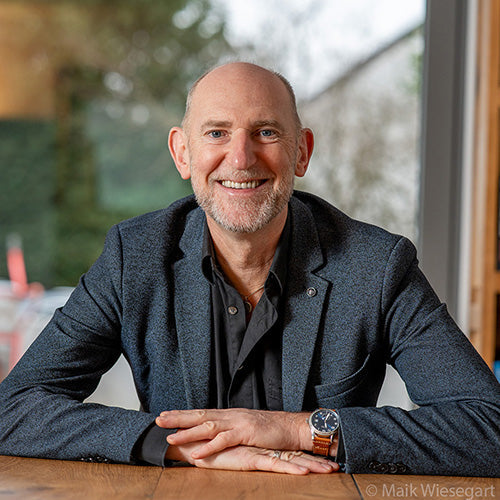
Andreas Winter: "When it comes to losing weight, it's not about how much or what we eat – but only about why we eat!"

Andreas Winter: "When it comes to losing weight, it's not about how much or what we eat – but only about why we eat!"
Interview with the depth psychologist and bestselling author
"The diet industry fights the body. In addition to food prohibitions, there are stomach operations, laxatives, tapeworms, satiety agents, and appetite suppressants on offer. All of this creates stress, feelings of shame, anger, and resistance. And it tackles the problem at the completely wrong end. My method, on the other hand, doesn't fight anything but helps to understand one's own body and emotions. Most weight loss programs ignore the crucial mechanism: fat is not created by eating, but by fear." The "Winter Diet," as the successful coach Andreas Winter, author of the guide "Losing Weight by Accepting," humorously calls his proven depth-psychological approach to weight reduction, is a kind of special treatment for our emotions: "It acts like a psychological security reform: when the inner alarm is switched off, the body sheds its protective ballast all by itself."
Your new book is the further development of everything that has proven successful in your depth psychological work. What has happened since the publication of your bestseller "Losing Weight Is Easier Than Gaining Weight"?
Winter: A lot! Since 2007, I have received countless letters from people who said: "I lost weight without a diet, without exercise, without torment – simply by understanding!" I found that wonderful. I felt that my approach had made an important contribution to understanding and treating obesity. Many weight loss coaches, trainers, and consultants have since incorporated my approach into their offerings. It is slowly getting around that gaining weight has nothing to do with overeating. Unfortunately, however, there were always people who said: "I understand everything, but I can't implement it." So I followed up: a practical book, an audiocoaching CD, DVDs, lectures, and hundreds of forum posts. And yet, there were some who failed despite all the tools. This led me to the crucial discovery: it wasn't a lack of motivation, but a lack of relevance. The temptation to stay in the comfort zone, where they had been settled for years, was too great. The new book is not an "optimization re-edition," but a further development. It is actually different from my previous books. Although, as usual, based on depth psychology, practical, humorous, enriched with all the case studies, experiences, and insights of the last decades – above all, it is one thing: an ambassador for peace with one's own body.
The diet industry is booming, and new miracle cures and programs come onto the market every year. Why is the number of overweight people still increasing worldwide, and what distinguishes the "Winter Diet" from other offerings?
Winter: It's quite simple: the diet industry fights the body. In addition to food prohibitions, there are stomach operations, laxatives, tapeworms, satiety agents, and appetite suppressants on offer. All of this creates stress, feelings of shame, anger, and resistance. And it tackles the problem at the completely wrong end. My method, on the other hand, doesn't fight anything but helps to understand one's own body and emotions. Most weight loss programs ignore the crucial mechanism: fat is not created by eating, but by fear – specifically, by the fear of scarcity. Cortisol, insulin, and many other neurotransmitters decide whether carbon and water are excreted, converted into energy, or stored as fat. Diets say: "Eat the right thing." I say: "Eat for the right reason!" I explain more about this in the book. My approach, which I sometimes call "the Winter Diet," is not a diet in the true sense... but it is a kind of special treatment, not for the body, but for the emotions. It acts like a psychological security reform: when the inner alarm is switched off, the body sheds its protective ballast all by itself.
You state that you haven't written a guide for a bikini figure, but an invitation to self-liberation. Why does it still succeed in losing excess pounds and perhaps even becoming a bit more attractive?
Winter: Because attractiveness has nothing to do with model measurements or fashion style, but with self-confidence. When we feel liberated, it shows – shoulders go up, eyes become alert, the face relaxes. The opening degree of the pupils and eyelids increases, we no longer appear anxious, controlling, perfectionistic, suspicious, but confident, appealing. In fact, many people lose weight just by reading, even before they have done the first exercise – simply because the insight into the causes of weight gain releases pressure and thus fewer stress hormones are produced. And a stress-free body is a natural aesthetic: it regulates itself. Beauty is a byproduct of inner security. A person who likes themselves radiates. And the body follows the thoughts. Not being thin makes you happy, self-confident, and attractive, but vice versa: self-confidence makes you happy, attractive, and thin.
 The "Winter Diet" does not demand discipline or abstinence from pleasure; rather, it helps to recognize and change the unconscious causes of eating behavior. Andreas Winter is concerned with nothing less than self-acceptance and the path to healing, freedom, and lightness. |
In your earlier books, you already put forward the provocative thesis that obesity is not caused by overeating, but by stress. What biological and psychological processes are behind this emergency program of the body?
Winter: I always have to smile when my statement is called a "provocative thesis" – I hear that often. We all consume many more calories than we burn, but not all of us get fat. Those who do are the ones who feel they have too little. This emotional stress releases messengers – especially cortisol – which turn water and carbon into fat. This connection is not new at all, by the way. The clinical basis about cortisol, emotions, and obesity comes from the US neurologist Harvey Cushing from 1912; modern basic research was primarily laid by the Swede Per Björntorp around 1990 to 2000 and supported by human studies such as those by Elissa Epel (USA 2000). Recognizing and resolving the weight gain pattern takes a little time, but you don't have to throw money at the diet industry for it – and you certainly don't need a weight loss injection or a gastric band.
Losing weight is not only easier than gaining weight, but it happens automatically through acceptance – to summarize your message somewhat briefly. Please explain this in more detail: What actually needs to be accepted in order to ultimately get rid of something?
Winter: One has to accept the fact that one is not overweight because one is sick, lazy, or undisciplined, but because one has comforted oneself with food or thoughts of food during emotional stress. Comparable to a baby that gets the breast, bottle, or pacifier when distressed and is thereby "soothed," i.e., stops feeling threatened. Since this "emotional rescue" is not freely available at all times, but limited, one tries to get more of it or hold on to it. This realization causes feelings of shame in some people. But whoever internalizes it automatically loses weight because food simply no longer has the meaning of emotional rescue, but only represents nourishment and can be let go.
 The depth psychological approach helps to resolve unconscious emotional burdens and thus promotes inner healing and a healthy relationship with one's own body, which then sheds excess pounds as if by itself. The practical ten-day program helps with the implementation: "an everyday accompanying program that has a more profound effect than any calorie chart," says Andreas Winter. |
You claim at one point: Anyone who develops self-confidence will automatically become slimmer and more beautiful. Doesn't this also confirm a beauty or slimness ideal that prevails, especially in social media, and is ultimately discriminatory?
Winter: Absolutely not, because anyone who truly has self-confidence and self-assurance doesn't need this beauty ideal theater. We perceive people who struggle to be considered attractive as less trustworthy and therefore also less appealing than people who radiate a natural beauty through contentment. Furthermore, I believe that people who have good self-confidence do not join in where perfect bodies and ideal figures are faked with the help of discipline and surgery. Beauty is not a BMI, but a state of the nervous system. A relaxed person is more beautiful, healthier, more alive – regardless of clothing size or Instagram aesthetics. So I am not confirming the discriminatory, but the liberating: a person becomes more beautiful when they stop measuring themselves against "ideals."
Many people who want to lose weight often fail due to the demands placed on them from outside – for example, by doctors or nutritionists or by friends and family. What advice would you give those affected on how to deal with relapses?
Winter: Yes, the "anti-coaches," as I call them, can unfortunately sabotage success. Most do not fail because of themselves, but because of their anti-coaches – those well-meaning people who say, "Do you really want to eat that?" or "Just exercise more!" This can be very unsettling. Especially if you are still at the beginning of your unusual weight loss journey. But the more self-confident you become, the less you are influenced by someone else's half-knowledge – even if they are wearing a white coat and smart glasses. However, it can be a long road until then. The good news: what many consider relapses are not setbacks, but stages. Maturation processes can proceed in waves. Relapses are like stumbling when learning to walk: annoying, but completely harmless. And with every step you take, you become more confident and better.
 Losing Weight by Accepting Mankau Verlag, 1st ed. February 2026 Paperback, 13.5 × 21.5 cm, 190 p. ISBN 978-3-86374-794-7 €18.00 (D) | €18.50 (A) More about the book → |
|
Audiobook:
1 MP3-CD in Jewelcase, 8-page booklet Total running time approx. 304 min. ISBN 978-3-86374-797-8 RRP €18.00 (D/A) More about the audiobook → Also available as audio download: €12.99 → |
Recommended Links:
More information about the book "Losing Weight by Accepting" →
To the reading sample in PDF format →
More information about the audiobook "Losing Weight by Accepting" →
More about author Andreas Winter →
Our social networks – for questions, criticism, suggestions →
This might interest you








More articles

Philip Kunisch: "Nature awaits eyes that see it!"
Herbalist Philip Kunisch, author of the compact guide "Edible Medicinal Herbs and Wild Plants", considers it extraordinarily valuable, especially for us modern people, to rediscover the ancient kno...
Read more
Diverse range of books
We offer a wide range of books on health, self-help and personal development.

Inspiring authors
Our more than 120 authors are experts in their fields and are happy to share their wealth of experience.

Practical guides
Our books and media are practice-oriented and offer helpful tips and instructions for everyday life.

New releases
We continuously publish new books and audio guides that address and delve deeper into current topics.