

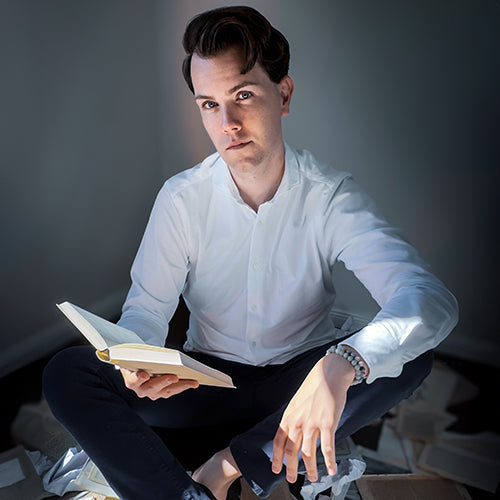
Thomas Lambert Schöberl: "Love is the invisible thread that unites all dimensions, and grows with every word we dedicate to it."

Thomas Lambert Schöberl: "Love is the invisible thread that unites all dimensions, and grows with every word we dedicate to it."
Interview about the book 50 Words for Love
"In a time when many people suffer from speechlessness – be it due to personal trauma or societal divisions – we need new ways to touch the unspeakable. '50 Words for Love' is aimed at readers who are looking for a more intense relationship with life, want to discover their inner richness, and strengthen or question their belief in love and in life. For love is like a spark that does not diminish by sharing, but becomes brighter." With his book "50 Words for Love", Thomas Lambert Schöberl wants to open a door to new perspectives and experiences for us. Because, in his opinion, love has the power to shape us, to heal us, and to unite us.
Your new book "50 Words for Love" contains inspirations that aim to touch the heart. What inspired you to write this book yourself?
Schöberl: Sometimes you need a detour to get to the core of something. For me, it was encountering the fascinating myth that the Inuit had 50 different words for snow. This supposed linguistic sophistication, coupled with Kate Bush's musical masterpiece "50 Words for Snow", became the key to a project that had been simmering within me for a long time: a book about the infinite facets of love. For what is love, if not the great mystery that defines our humanity? It is like a prism through which all our experiences shimmer. In a time when we like to break everything down into measurable units or transform it into quickly consumable entertainment, I wanted to give love back its poetic dimension. What if our language was born from our deepest human longing: to give and receive love? Some anthropologists suspect that language itself arose from love – from the need to create closeness and express affection. Perhaps it was this first poetic act of humanity – the transformation of feeling into sound – that shaped us into the storytellers we are today. I wanted to explore exactly this magical origin in 50 different facets.
Love is probably the most described and sung about phenomenon of human life – yet you passionately call for a new perspective on love. Which facets of love, in your opinion, have not yet been explored?
Schöberl: Love doesn't just dance in the ballroom of romance. Its true realm is a kingdom of heaven on Earth. It is the architectural force behind our cities, the creative spark in our art, the humble hand in our dealings with nature. It manifests in every conscious decision to make our world a little better. For too long, love has been primarily defined through a male, heterosexual lens. Today, female, queer voices, homosexual narratives, and non-binary perspectives expand our understanding of what love can be – but this change is still in its infancy and its achievements must be defended. The maturity and quality of life of a society is precisely reflected in how it embraces diversity, how it protects minorities, how it not only tolerates otherness but sees it as an enrichment. It is the ability to love that is mirrored in a strong welfare state, in lived tolerance, in the appreciation of diverse life designs. Love appears in infinitely many forms: It is the invisible bond that unites all these dimensions and gives our existence that special possibility we call "a free life."
You studied musicology, art history, theatre studies, and Protestant theology, and you work as a naturopath in your own practice. How do you combine all these areas, and what is special about your interdisciplinary approach?
Schöberl: For me, science, art, and faith are like sisters from an ancient family. They find their common home in nature – where our ancestors in the first "cathedrals," the caves of the Stone Age, painted, made music, and laid the foundation for our spiritual quest. This original unity of sound, image, and the sacred extends into our time. I felt this connection even as a child – in Bach's music, in Hildegard of Bingen's holistic wisdom, in the transformative power of theater, where fantasy, community, and spirituality merge into a higher unity. My academic path was the natural continuation of this early fascination. As a naturopath, I create spaces that connect with this holistic tradition. My practice is like a modern, free monastery where art, sound, the search for meaning, nature, and silence meet. In my workshops, I invite people to listen to their own melody and to shape their lives as a creative response to this inner voice.
You speak at one point of a "poetic lexicon of love," but it's not a kind of instruction manual on how to love correctly or successfully. What is the book's goal instead, and what kind of readers do you hope to reach?
Schöberl: A lexicon is usually a place of definitions – but my "poetic lexicon of love" instead opens up spaces of possibilities. It is an invitation to expand our linguistic and emotional horizons, because our capacity for love grows with the diversity of our inner images. When we take up the words and stories of previous generations, retell them, and fill them with our own meanings, we create a more vibrant language of love. The form of the lexicon is a conscious choice: like love itself, it is a living organism that is constantly changing. In poems, stories, and imaginative dictionary entries, languages, dialects, and newly invented terms blend into a symphony of feeling. It is not a finished work, but a creative impulse that invites one to discover and create for oneself. In a time when many people suffer from speechlessness – be it through personal trauma or societal divides – we need new ways to touch the unspeakable. My book is aimed at all who are ready not to "overthink" love, but to explore it with all their senses. For love is like a spark that does not diminish by sharing, but becomes brighter. It grows in every word we give it, in every story we tell about it. The first 50 words are just the beginning of an endless journey of discovery. The book is aimed at readers who are looking for a more intense relationship with life, want to discover their inner richness, and strengthen or question their belief in love and in life. It is for those who are looking for ways to express their feelings and wish for more creativity and inspiration in their daily lives.

Just as the light of a candle does not diminish when we pass the flame to others,
so too does our love grow the more we share it.
You understand love as more than just a feeling, namely a way of life with the power to heal. How can this attitude be expressed in a reality dominated by distrust and misunderstanding, as well as crises and catastrophes?
Schöberl: For me, love is an umbrella term under which diverse experiences and states unite – like snow, which consists of millions of unique flakes. Each of these flakes is a work of art in itself, individual and transient. But it is precisely in their transience that their value lies. Snow, fleeting and of timeless beauty, like love, grants us a mindful "moment of eternity." It lifts us out of the mundane and invites us to fall like the flakes themselves – in the sense of "to fall in love." And precisely because snow is not always available, because it is not under our control, it has something magical about it. Love resembles this magic: it requires dedication, humility, and trust. We overcome distrust through faith – in ourselves, in others, and in love. Giving trust, even to those who may not seem to deserve it, is also an act of love – I call it "humility," "generosity," "forgiveness." It means building bridges where reason wants to tear them down. But this trust begins with ourselves: True love does not create dependencies, but teaches us patience and serenity, so that we can give without immediately demanding something in return. And if we believe that we cannot fall deeper than into the hands of love, then falling becomes a "letting go," a surrender; or, as I write in my book, a true leap into "heavenly expanse and deep-sea blue." Anyone who believes in love is not a fool – but a person who has the courage for critical reflection, who never stops learning, and who knows when it is time to believe and let go. Love may be extravagant, but it is precisely in this extravagance that its beauty lies. And in that seemingly foolish moment, when all heaviness falls away from us, supposed foolishness transforms into a wisdom that gives our fall, our life, "bearing."
Many relationship problems begin when we don't know and love ourselves. How can this self-love be achieved without drifting into egoism or narcissism?
Schöberl: Many conflicts, whether in personal relationships or in a societal context, are rooted in a lack of love – be it through lack of experience or the unlearned ability for self-love. What manifests as aggression, rejection, or indifference is often a hidden cry for attention. But true self-love differs fundamentally from egoism or narcissistic patterns. Egoism arises from a deep survival mode – the fear of falling short or not getting enough. Narcissism, on the other hand, is paradoxically an expression of fundamental insecurity, which is compensated for by control and dominance. Both behavioral patterns are defense mechanisms that try to fill an inner void. True self-love shows itself differently: It is the ability to accept oneself and to perceive one's own needs without constantly judging oneself. It manifests in clear communication, healthy boundaries, and the courage to be vulnerable. A person who loves themselves is at peace within themselves and doesn't need to take anything – they give freely, because love multiplies through sharing. It creates an inner richness that expresses itself in generosity, respect, and the appreciation of diversity.

Book recommendation:
Thomas Lambert Schöberl: 50 Words for Love. Inspirations that touch the heart. Mankau Verlag, 1st ed. January 2025, Hardcover 13.5 × 18.5 cm, 222 pp., 18.00 Euro (D) | 18.50 Euro (A), ISBN 978-3-86374-728-2
Recommended links:
Further information about the book "50 Words for Love"
To the reading sample in PDF format
More about author Thomas Lambert Schöberl
Our social networks – for questions, criticism, suggestions
More articles
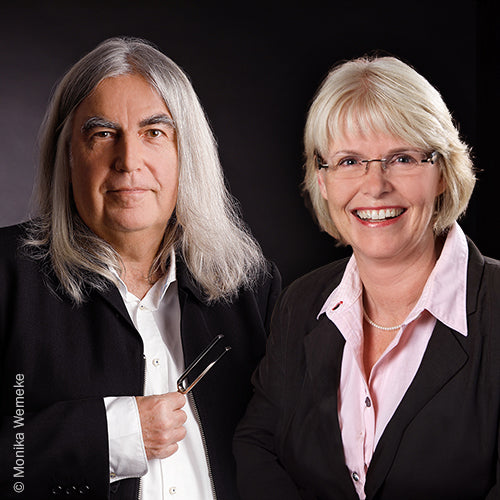
Tuning Fork Therapy: "Tuning Fork Balancings heal and protect us!"
"We humans are energy beings, and only when our life energy can flow freely and undisturbed through our organism are we completely healthy. Here, the vibration of the tuning forks acts like a promp...
Read more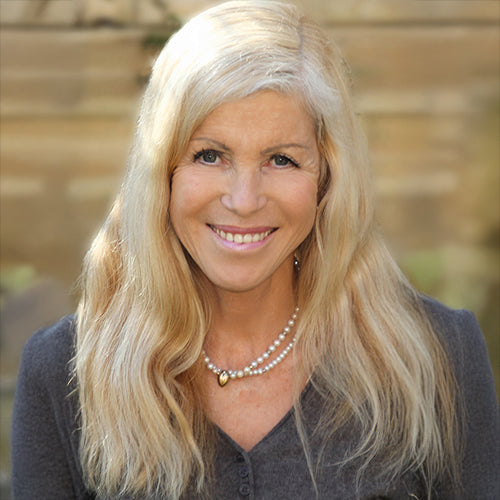
Green All-Rounders: "Thanks to culinary herbs, our food becomes medicine!"
"For my top ten green all-rounders, I have selected ten well-known culinary herbs whose amazing healing powers are sufficiently scientifically researched and proven. Surprisingly, studies were ofte...
Read more
Diverse range of books
We offer a wide range of books on health, self-help and personal development.

Inspiring authors
Our more than 120 authors are experts in their fields and are happy to share their wealth of experience.

Practical guides
Our books and media are practice-oriented and offer helpful tips and instructions for everyday life.

New releases
We continuously publish new books and audio guides that address and delve deeper into current topics.